Let us say it straight away: the electric outboard has not won on every count, and petrol is not finished. Each is better somewhere, and the criterion that decides is neither price nor ecology — it is how you actually use your boat.
This comparison says what each one does better, what it really costs over five years, and who it suits.
What electric does better
- Silence. The first argument, and the one no spec sheet conveys. No vibration through the tiller, no two-stroke scream, no fumes. You can hear each other aboard.
- Instant torque. An electric motor gives full force at zero rpm. Harbour manoeuvres are smoother and more precise, without a combustion engine’s delay.
- Maintenance. No oil change, no spark plugs, no fuel filter, no carburettor to strip in spring. A rinse in fresh water and an eye on the battery is enough.
- Starting. Nothing to prime, nothing to pull, nothing that refuses after three weeks idle.
- Protected waters. More and more anchorages, reserves and lakes ban combustion engines. Electric gets in.
- Fuel you no longer buy. A charge costs a few tens of cents where a tank costs several euros.
What petrol still does better
Passing over this would be dishonest, and you would find out anyway.
- Range at speed. This is the hard point. To go fast and far, a tank still beats a battery — fuel carries far more energy per kilo.
- Refuelling. A fuel dock takes five minutes; a charge takes hours. On a long coastal passage, that changes the plan.
- Purchase price. At comparable power, electric costs more to buy. It catches up in use, not in the shop.
- The service network. A mechanic for a petrol outboard exists in any port in the world. The electric network is being built; it is not everywhere yet.
The table that decides
| Electric | Petrol | |
|---|---|---|
| Noise | Near silent | 70 to 90 dB |
| Emissions aboard | None | Exhaust and fumes |
| Annual servicing | Rinse and battery check | Oil, plugs, filters |
| Low-speed torque | Maximum from 0 rpm | Progressive |
| Range at low speed | Excellent | Good |
| Range at high speed | Limited | Excellent |
| Refuelling | Hours (dock socket) | Minutes (fuel dock) |
| Purchase price | Higher | Lower |
| Running cost | Very low | High |
| Protected areas | Allowed | Often banned |
The real sum: what it costs over five years
Comparing price tags makes no sense. What counts is total cost over the years you own it: purchase, fuel or electricity, servicing, winterising, and resale value.
Petrol starts ahead on purchase and loses ground every season: fuel, the annual service, wear parts, winterising. Electric starts behind and claws nothing back in year one — then opens the gap faster the more you use the boat.
The simple rule: the more you go out, the sooner electric becomes the cheaper option. A boat used three weekends a year will never recoup the difference; a tender used every day of the season will.
Which motor for which use?
Sailing tender, shuttling from the anchorage
Electric, without hesitation. This is where it wins on every count: short trips, low speeds, frequent manoeuvres, charging at the boat, and silence that matters particularly at six in the morning. The Momentum U2, 2.5 kW, covers this programme.
RIB, yacht tender, workboat
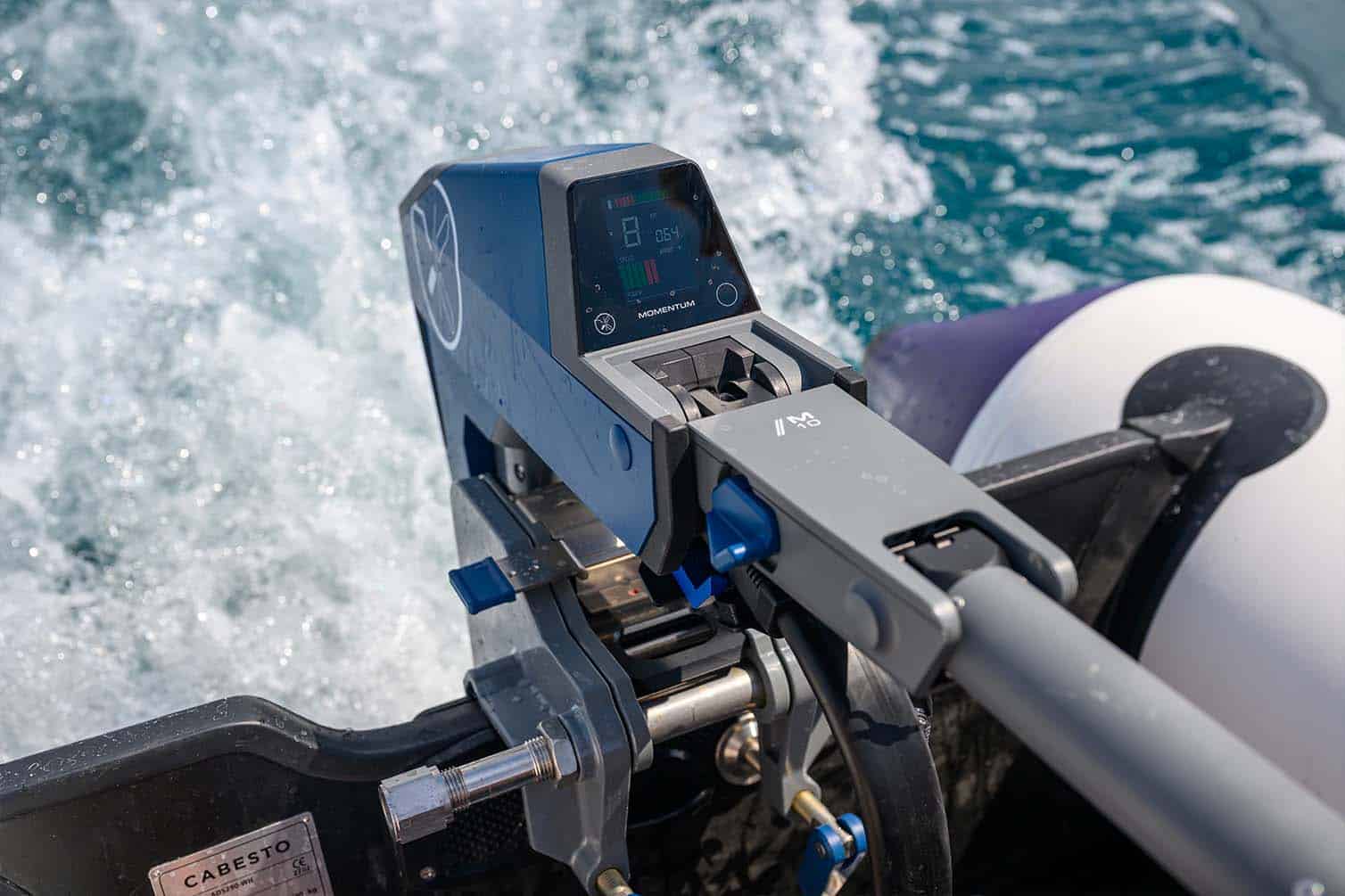
Electric holds up, provided you accept choosing your speed. The Momentum M10, 10 kW, replaces a 15 to 20 hp petrol outboard and gives 25 nm at 5.6 knots or 15 nm at nearly 12 knots. For shuttling and transfers, that is more than enough.
Sailing boat, harbour and auxiliary propulsion
Electric is the right call. You motor slowly by definition, and that is exactly where range becomes very long: 152 nm at 2.2 knots on the M10.
Offshore fishing, long fast passages
Petrol keeps the advantage today. A hundred miles at twenty knots needs an amount of energy no reasonable battery carries yet. Better to say so plainly.
Frequently asked questions
Is an electric motor powerful enough for my boat?
The useful comparison is not horsepower but thrust. A 2.5 kW U2 matches a 3 to 5 hp petrol outboard, a 10 kW M10 a 15-20 hp. At equal power, electric delivers its torque earlier, which often makes it livelier off the mark.
What happens if the battery goes in the water?
Marine batteries are sealed and built for salt water. That does not exempt them from a fresh-water rinse, like the rest of the motor.
Can you charge aboard from a solar panel?
Yes, and on a sailing boat it is a natural pairing: solar rebuilds the charge through the day at anchor. The rate depends on the panel area installed.
What about resale?
The second-hand electric market is young, so harder to predict than petrol. On the other hand an electric motor has far fewer wear parts, and its condition depends mostly on the battery.
In short
If you go slowly, often, and over reasonable distances, electric is already better — not just cleaner. If your programme is speed over long distances, petrol remains the right tool, and there is no shame in saying so.
The best way to decide is to take the tiller. Find a Momentum dealer for a sea trial, or send us your question with your boat and your programme: the answer will be more useful than any comparison.